
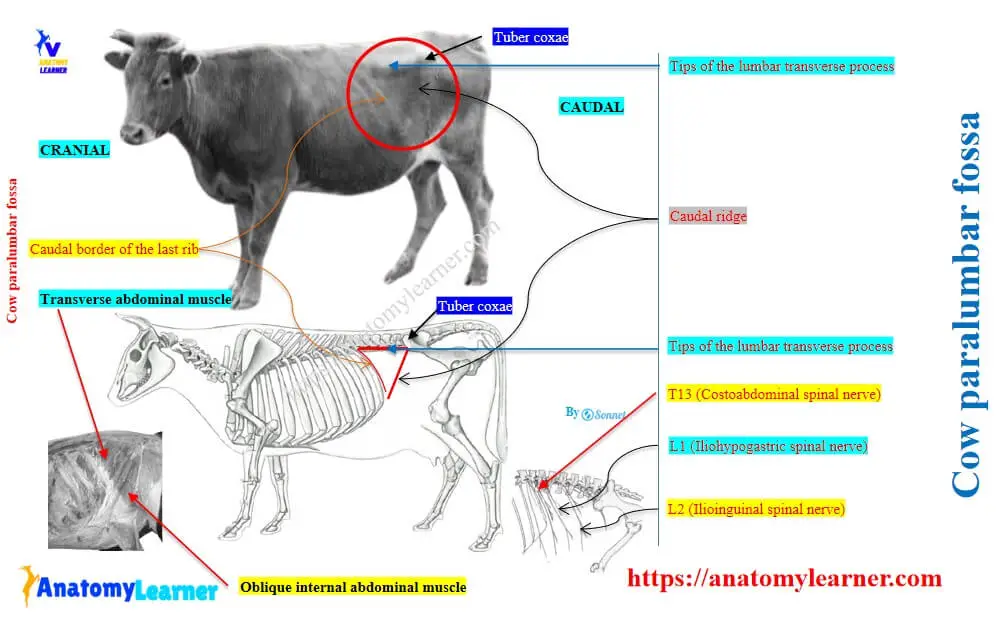
The cow paralumbar fossa is a clinically important structure and a part of its flank. Here, you will learn the boundary and location of the cow paralumbar fossa, so that you may identify it practically from the live cow or any other ruminant.
Quick answer: the cow paralumbar fossa is a triangular, depressed area below the transverse processes of the lumbar vertebrae. It is a part of the upper flank and a clinically important area for ruminants.
I will describe the boundary / location of the paralumbar fossa with labeled diagrams from the cow’s abdomen.
Cow paralumbar fossa
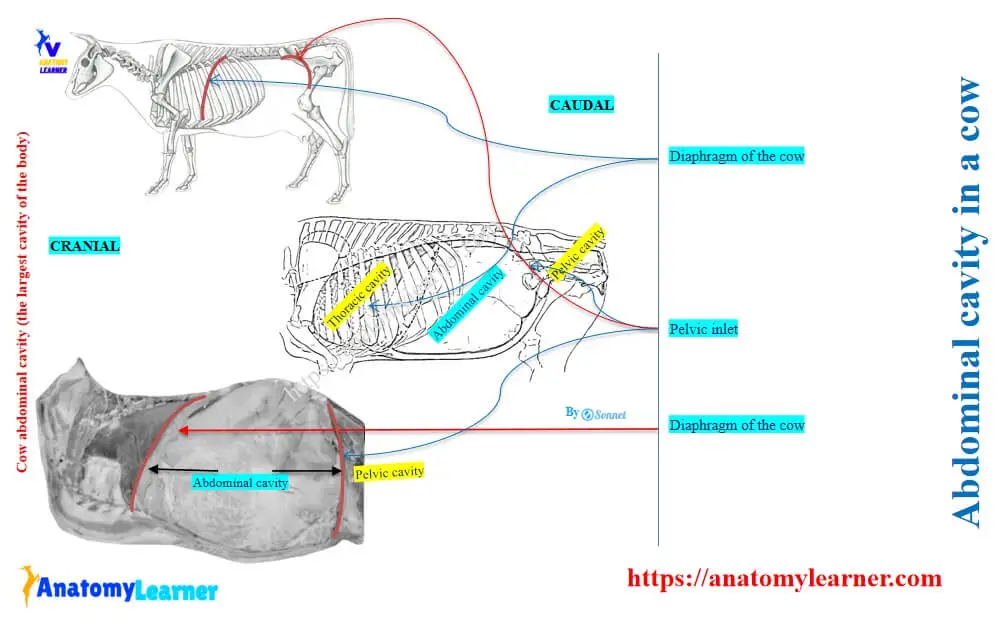
Before going to identify the paralumbar fossa, you might have basic knowledge of the cow’s abdominal cavity. It is the largest cavity of the cow’s body that extends from the diaphragm to the pelvic inlet (shown on the labeled diagram).
Again, the largest cavity is imaginarily divided by two sagittal and two transverse planes. Thus, there are 9 regions that will be available in the cow’s abdomen (shown in the figure).
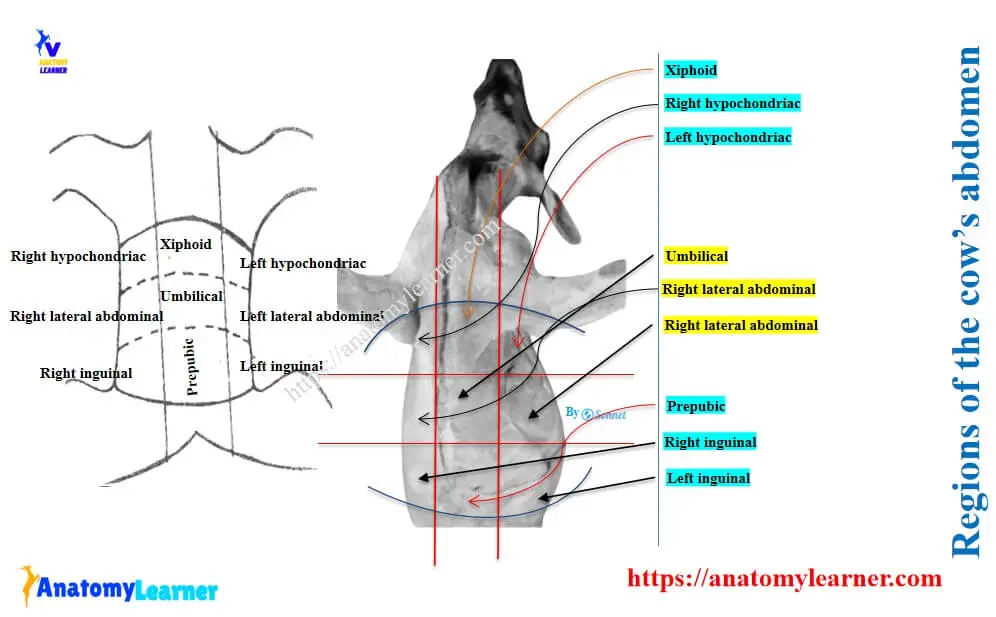
- Right hypochondric region
- Left hypochondric region
- Xiphoid region
- Left lateral abdominal region
- Right lateral abdominal region
- Umbilical region
- Left inguinal region
- Right inguinal region, and
- Prepubic region,
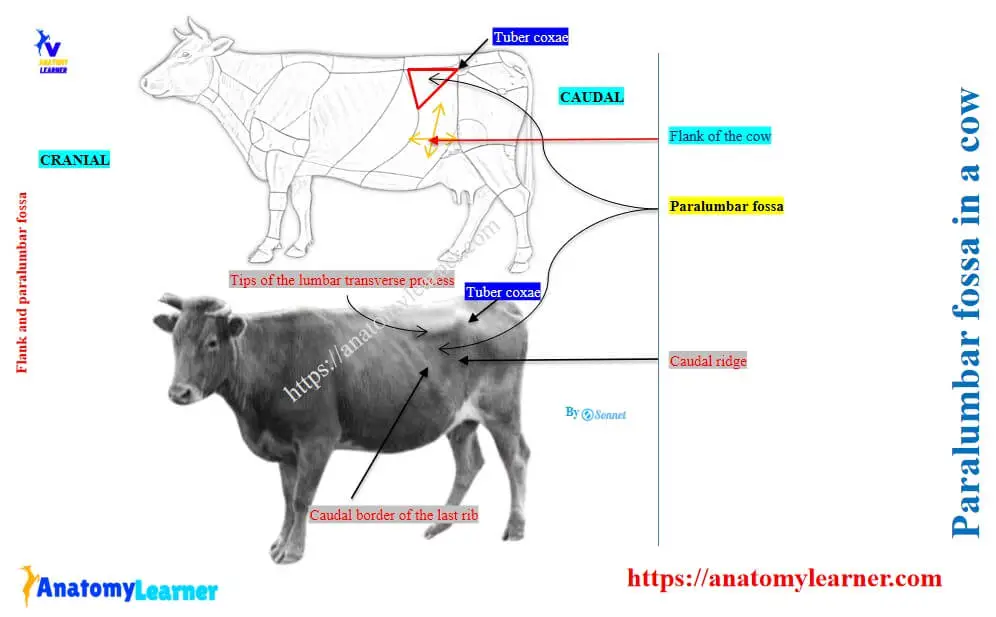
Now, let’s notice the labeled diagram of a cow’s flank that is mentioned below. It shows a depressed area in the upper flank region, just ventral to the transverse processes of the cow’s lumbar vertebrae.
This roughly triangular depression on the upper flank is the paralumbar fossa in a cow. It is clearly visible in the live cows, goats, buffaloes, and other ruminants.
- You may also learn – Where is the flank on a cow?
What are the boundaries of the paralumbar fossa in cattle or a cow?
There are right and left paralumbar fossa in the cow’s abdominal wall, where the left one is more visible and widely used for clinical purposes. The boundaries of the paralumbar fossa of the cow or cattle’s flank are formed by the followings –
- Cranial boundary: The cranial boundary of the cow paralumbar fossa is formed by the caudal border of the last rib (13th rib).
- Dorsal boundary: It is formed by the tips of the transverse processes (TP) of the lumbar vertebrae.
- Caudoventral boundary: this boundary is formed by the cord of the flank / hump / ridge formed by the internal obliquus abdominal muscle.
Here, the labeled diagram shows the boundaries of the cow paralumbar fossa (cranial, dorsal, and caudoventral limits).
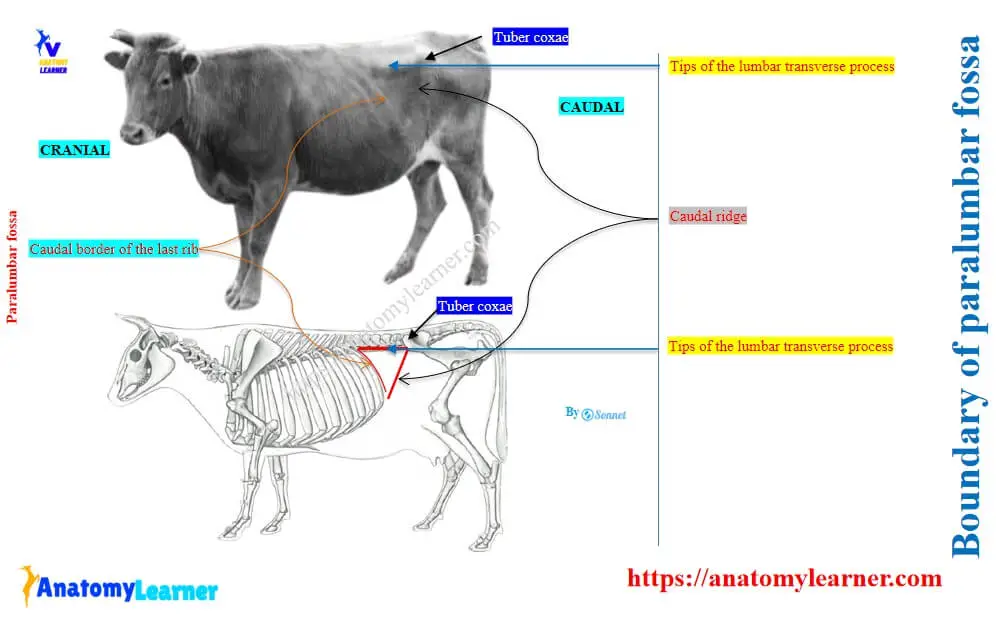
The cord of the flank (hump or ridge; shown in figure) is created because much of the obliquus internus abdominis muscle is suspended and fans out from the tuber coxae. Here, the external lateral projection of the tuber coxae forms the caudal ridge in the middle of the muscle.
What are the muscles that form the paralumbar fossa in cattle?
The following three abdominal muscles directly or indirectly participate in forming the paralumbar fossa in the cattle –
- Internus oblique abdominal muscle,
- Transverse abdominal muscle, and
- Externus oblique abdominal muscle,
Here, the figure shows two oblique and one transverse muscle from the cow’s abdomen that contribute to forming the paralumbar fossa.
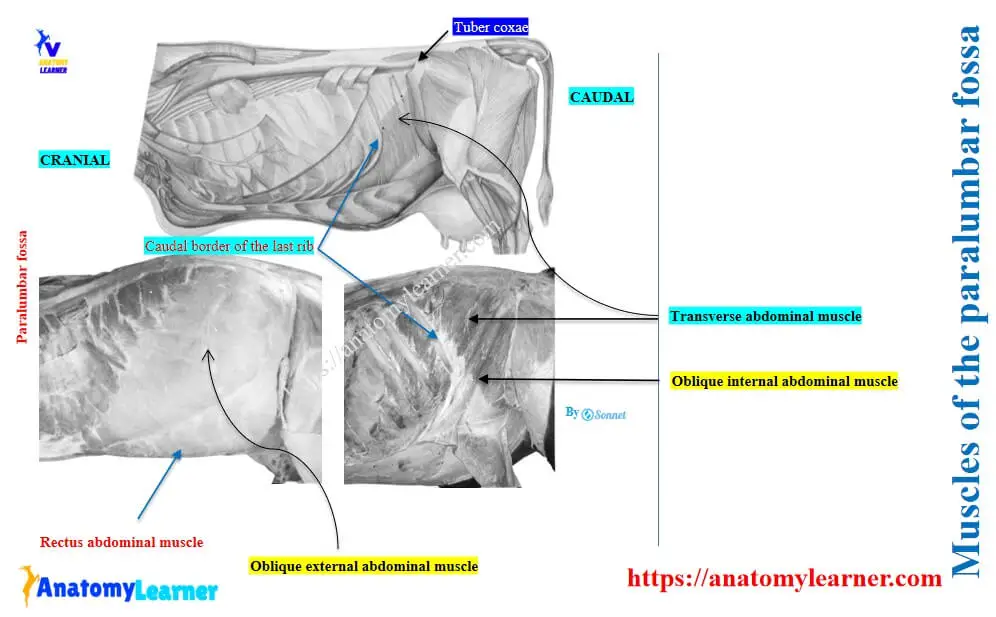
The internus oblique abdominal muscle lies deep to the externus and possesses a fleshy and apponeurotic part. Here, the fibers of this muscle course to approximately the level of the middle thigh region in a cranioventral direction.
The fleshy part of internus oblique muscle arises from the tuber coxae and also from the transverse process of the lumbar vertebrae. Again, the aponeurotic part inserts on the last rib (cranially) and the linea alba (ventrally).
The transverse abdominal muscle lies medial to internus oblique muscle. Its fibers run in a dorsoventral direction (verticle).
This abdominal muscle arises from the tips of the transverse processes (TP) of the lumbar vertebrae and also from the caudal border of the last rib. The fleshy part of the transverse abdominal muscle contributes to forming the paralumbar fossa region.
The external oblique abdominal muscle of the cow is the most superficial of its abdominal muscles. This muscle also consists of a fleshy and aponeurotic part, and its fibers run in a caudoventral direction.
The fleshy part of the cow’s external oblique muscle arises from the caudomedial part of 6 – 13 ribs and also from the thoracolumbar fascia. This fleshy part contributes to forming the region of the paralumbar fossa in cows or cattle.
At the level of the ventral half of the flank, the aponeurotic part of this externus muscle lies deep to the cutaneus trunci.
Nerves of the cow paralumbar fossa
Three spinal nerves T13 (costoabdominal), L1 (iliohypogastric), and L2 (ilioinguinal) run (dorsal and ventral branches of spinal nerve) along the paralumbar fossa in the cow. Here, the figure shows these 3 spinal nerves that pass over the paralumbar fossa.
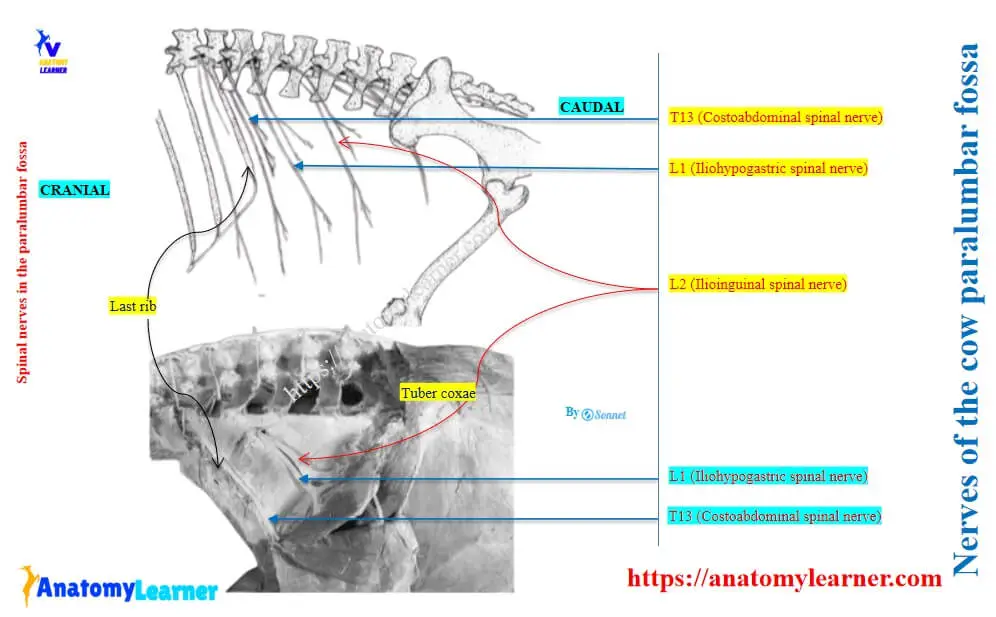
These spinal nerves (ventral branch) extend caudally in an oblique manner on the lateral surface of the transverse abdominal muscle. Before that, the individual spinal nerve exists from the spinal cord through the intervertebral foramen and divides into small dorsal and long ventral branches.
You may learn he details formation and distribution of a spinal nerve in an animal from the article mentioned below –
The dorsal branch of the T13, L1, and T2 spinal nerves innervate the epaxial muscles and the skin on the dorsal part of the paralumbar fossa. Again, the ventral branch of these spinal nerves innervates the abdominal muscle (including the paralumbar fossa), peritoneum, and the rest of the ventral skin of the flank.
Why is the paralumbar fossa important for animals?
The paralumbar fossa is clinically important in blocking the flank region of the animals specially for the ruminant. Its site is commonly incised for access to the rumen and other abdominal organs.
Conclusion
So, the cow paralumbar fossa is a rough triangular area in the upper flank. The cranial border of this fossa is bounded by the caudal border of the thirteen rib in a cow.
Again, the dorsal limit starts from the distal end of the lumbar transverse processes. The internus oblique abdominal muscle forms a caudal ridge on its middle that forms the caudal boundary of the paralumbar fossa.
