
The elbow in a cow is a synovial joint of its forelimb. It is formed between the distal extremity of the humerus and the proximal extremity of the radius and ulna bones. Here, you will learn the type of this elbow joint along with its details anatomical features from a cow.
Quick answer: the elbow in a cow is a synovial ginglymus type joint located between the distal extremity of the humerus (DEH) and the proximal extremity of the radius and ulna.
However, I will explain why this cow’s elbow is a ginglymus-type synovial joint. You will also know the type of movement of this synovial joint and as the movement, including bone involvement and ligaments, with diagrams.
What type of joint is a cow elbow?
The cow’s elbow is a true ginglymus joint formed by the humeral condyle meeting the proximal end of the radius and ulna. But it is a composite joint that consists of radio-ulnar articulation and humero-radial articulation.
- Type of the radio-ulnar articulation: cartilaginous in young, and fibrous in older cows, and
- Type of the humero-radial articulation: ginglymus or hinge (synovial joint),
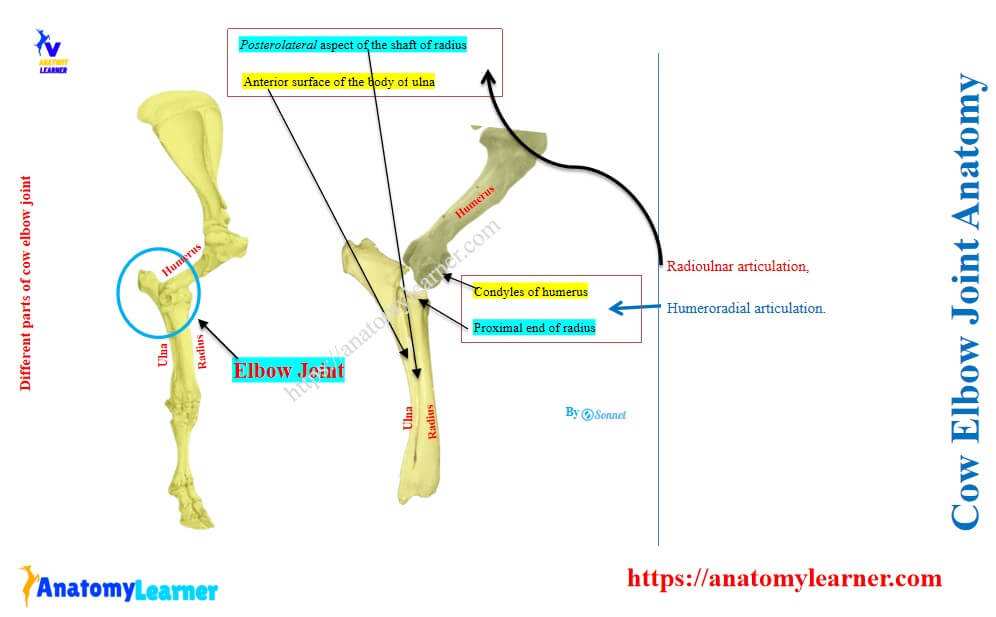
Another name for the cow’s elbow is the cubital articulation. Here, the figure shows the different parts of the cow’s elbow joint (humero-radial and radio-ulnar articulations).
There are three types of joints in animals or a cow’s body: synovial, fibrous, and cartilaginous. The synovial or diarthrodial joints are the movable joints of animals that exhibit different types of movements.
Again, the fibrous or synarthrodial joints are the immovable joints, especially found in the cow’s skull. The cartilaginous or amphiarthrodial joints are the joints of restricted movement.
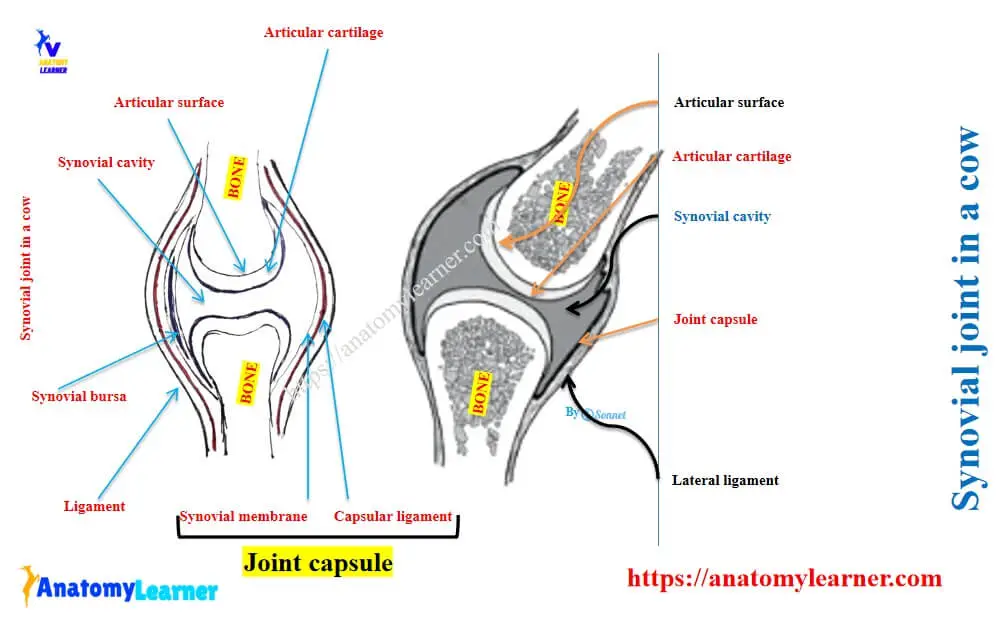
The synovial joint is known as the true joint of the animal’s body. This type of joint consists of the articular surface, articular cartilage, joint capsule, synovial cavity, and different types of ligaments.
Here, the figure shows the different components of the typical synovial joint from a cow.
Why is the cow’s elbow ginglymus joint?
Before explaining why the cow’s elbow ginglymus joint is, you might know the basics of the synovial joint’s movements and classification –
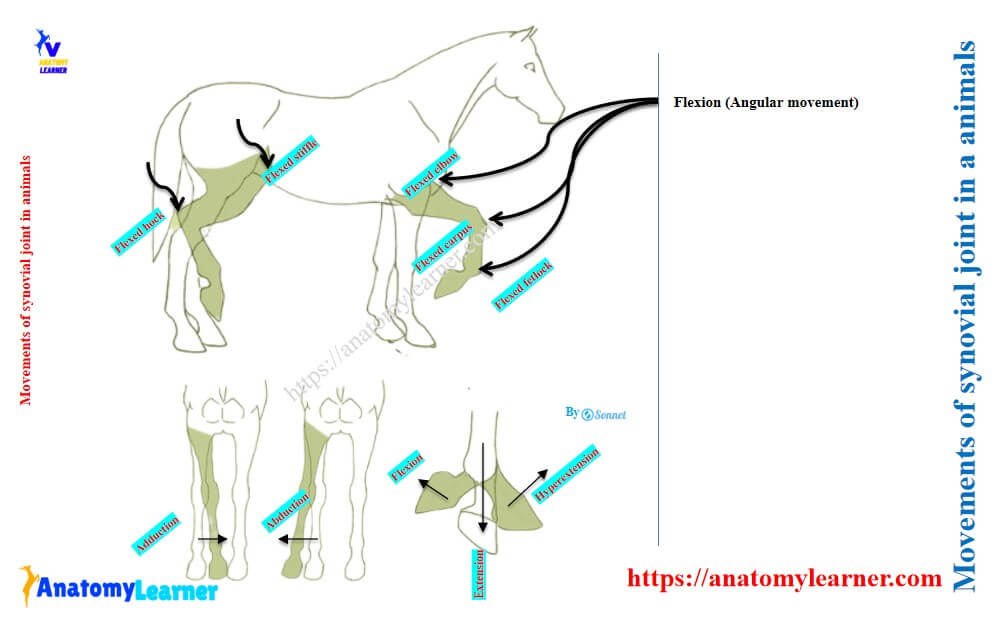
- Movements of the synovial joint: the synovial joint exhibits gliding, different types of angular movements (extension, flexion, abduction, and adduction), circumduction, and rotation.
- Classification of synovial joints: The synovial joints are classified according to the type of joint surfaces and axis of movements. The uniaxial, biaxial, and multiaxial are the main classifications of synovial joints on the basis of the axis of movements.
The figure shows the different types of movements of the synovial joint in cows.
In the uniaxial movement, the joints are permitted to move only in one plane of the cow’s body. Hinge or ginglymus and pivot joints belong to this uniaxial movement.
The hinge or ginglymus type of synovial joint is most common in most domestic animals, including the cow, goat, and horse.
Okay, now explain why the cow’s elbow ginglymus joint –
- First, it is a synovial joint as it has the ideal components of a typical synovial joint,
- Second, a cow’s elbow moves only in the sagittal plane of the body, and
- Third, it is responsible for the extension and flexion of the cow’s forelimb,
As the hinge or ginglymus move only in the sagittal plane and their main movements are extension and flexion, the cow’s elbow is grouped under it.
Cow elbow joint anatomy
As the cow’s elbow joint consists of 2 parts, I will describe the anatomical features of both. I will cover the following from both humero-radial and radio-ulnar articulations of the cow’s elbow –
- Bone involvement in these articulations,
- Movements of the humero-radial and radio-ulnar articulations, and
- Types of ligaments in both humero-radial and radio-ulnar articulations,
Bone involvement in the elbow joint
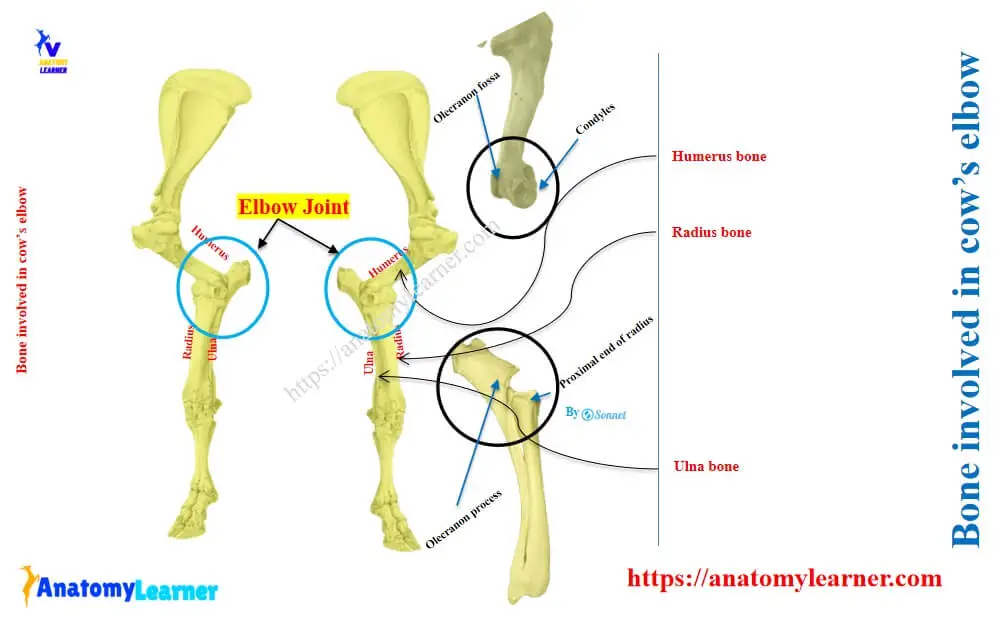
Humero-radial joint: in the humero-radial joint, the bones and articular surfaces are –
- A trochlear surface formed by the condyle of the cow’s humerus and the ridge between them, and
- Corresponding glenoid cavities and groove on the proximal end of the radius bone, together with the semilunar notch of the ulna bone,
Radio-ulnar joint: caudo-lateral aspect of the body of the radius bone and the cranial surface of the body of the ulna bone.
Here, the figure shows the bone involvement in both the humero-radial and radio-ulnar articulations of the cow’s elbow.
Movement of the humero-radial joint: extension and flexion around the long axis,
Movement of the radio-ulnar joint: very restricted in young calves and immovable in older cows. The forearm of a cow is being fixed in the position of pronation.
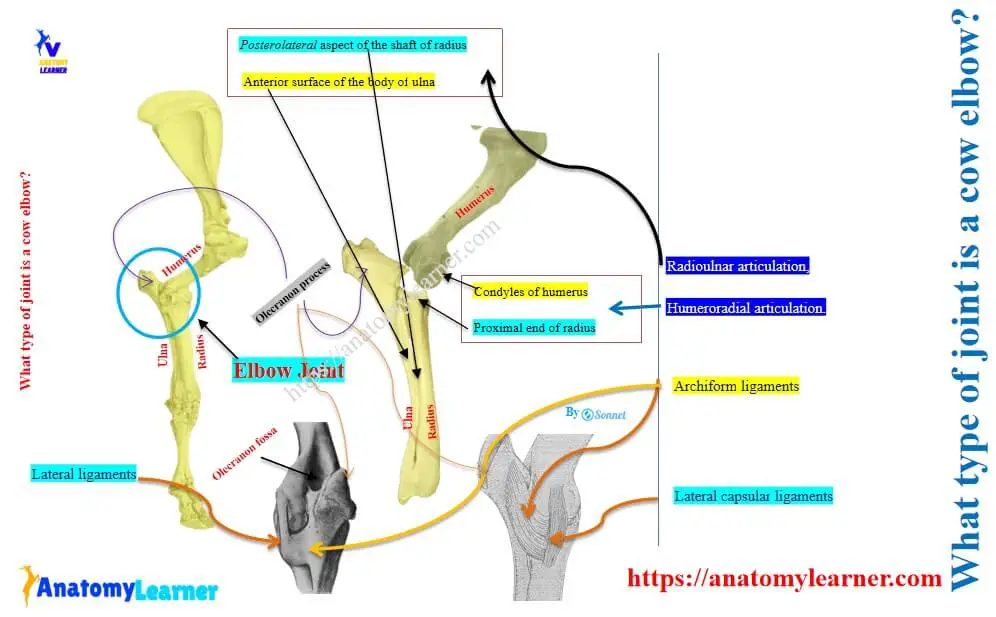
Ligaments of the humero-radial joint of the cow’s elbow
You will find the following ligaments in the humero-radial articulation of the cow’s elbow –
- Joint capsule (extremely thin),
- Medial collateral ligament (divides into 2 parts), and
- Lateral collateral ligament (short and strong)
The joint capsule of the humero-radial articulation of a cow’s elbow is thin and forms a small pouch in the olecranon fossa. Again, this ligament is strengthened by the oblique anterior ligament cranially and fuses with the collateral ligament.
The medial collateral ligament attaches above the prominence of the medial epicondyle of the humerus. This ligament divides into long superficial and short deep parts in a cow.
The superficial part of the medial ligament inserts on the medial border of the cow’s radius, just below the level of the interosseous space. Again, the deep part of this ligament inserts into the medial tuberosity of the radius bone.
The lateral collateral ligament attaches above to the depression on the lateral epicondyle of the humerus. Again, it extends to the lateral tuberosity of the cow’s radius bone.
Ligaments of the radio-ulnar articulation of the cow’s elbow
You will find the following ligament in the radio-ulnar articulation of the cow’s elbow joint –
- Joint capsule or capsular ligament,
- Interosseous ligament of the forearm, and
- A transverse or archifrom ligament,
The figure shows the different ligaments of the cow’s elbow joint (both from humero-radial and radio-ulnar articulations).
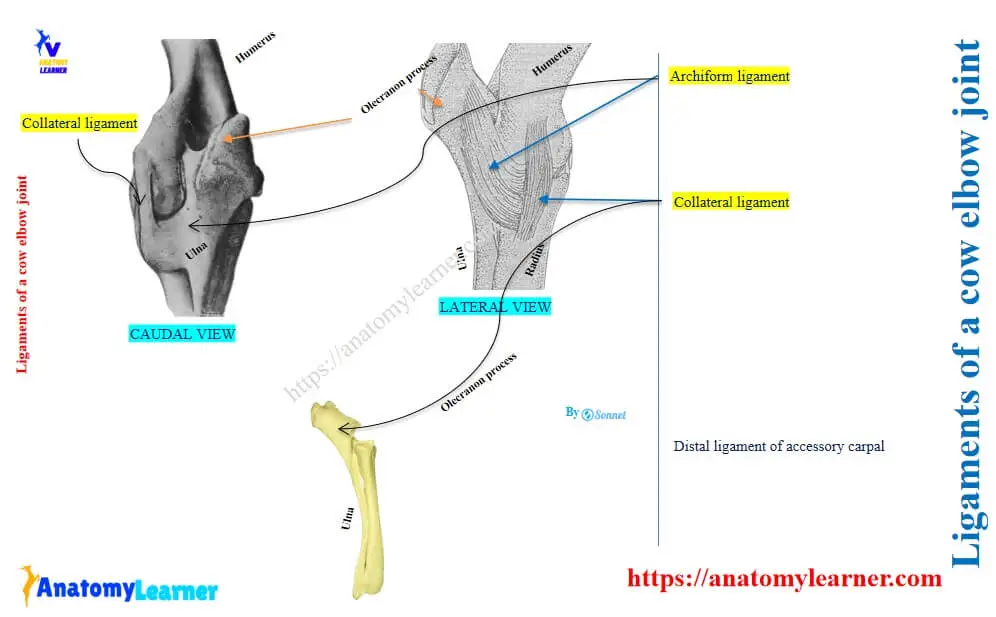
Here, the capsular ligament encloses the joint above the proximal interosseous space. The interosseous ligament helps to attach the shaft of the ulna to the radius above and below. At the upper interosseous space, this ligament usually persists, but may undergo more or less ossification in extreme older age.
The archiform or transverse ligaments are the lateral and medial, and the arch shape. They connect the corresponding aspect of the proximal extremity of the cow’s radius and ulna bones.
These archifrom ligaments bend with the corresponding collateral ligaments of the humero-radial articulation.
What is the elbow joint called in a cow?
The elbow joint is called the cubital articulation or articulatio cubiti. It is also known as the composite joint that comprises of radio-ulnar articulation and the humero-radial articulation.
The proximal radioulnar articulation is enclosed within the common capsule of the elbow joint. It is formed by two small concave facets on the ulna bone and corresponding facets on the posterior surface of the proximal extremity of the radius.
The distal extremity of the ulna fuses early with the radius bone. Thus, it is regarded as part of the elbow joint.
Where is a goat’s elbow?
The goat’s elbow is also located in the forelimb between the distal end of the humerus (DEH) and the proximal end of the radius and ulna (PERU). The structural components of the goat’s elbow are similar to the structure of the cow’s elbow.
The capsular ligament in the goat’s elbow is much thinner than that of the cow’s elbow. Again, the lateral collateral ligament of the humero-radial articulation in a goat is less strong than that of the cow’s elbow.
What is a goat’s knee called?
The goat’s knee is a composite joint, which is called the carpal joint. It is formed by the union of the distal extremity of the radius and ulna bones, two rows of carpals, and the distal extremity of the metacarpals.
Thus, the knee of a goat consists of radioulnar articulation, intercarpal articulation, and carpometacarpal articulation. Again, the goat’s intercarpal articulation consists of proximal and distal carpal joints.
Conclusion
So, the elbow in a cow is a synovial ginglymus type joint of the forelimb. It is located between the distal extremity of the humerus and the proximal extremity of the radius and ulna bones.
