
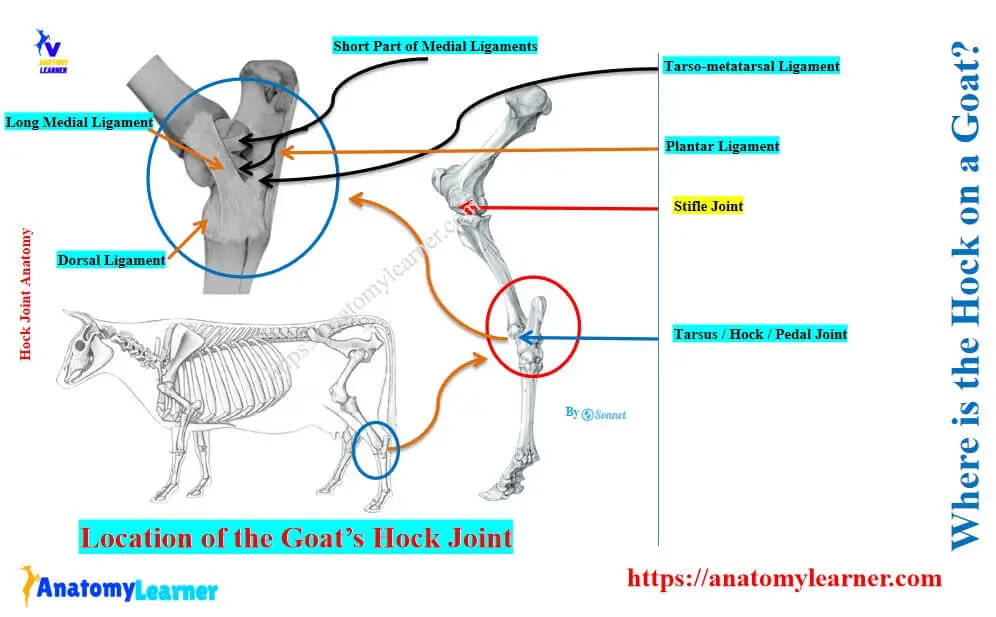
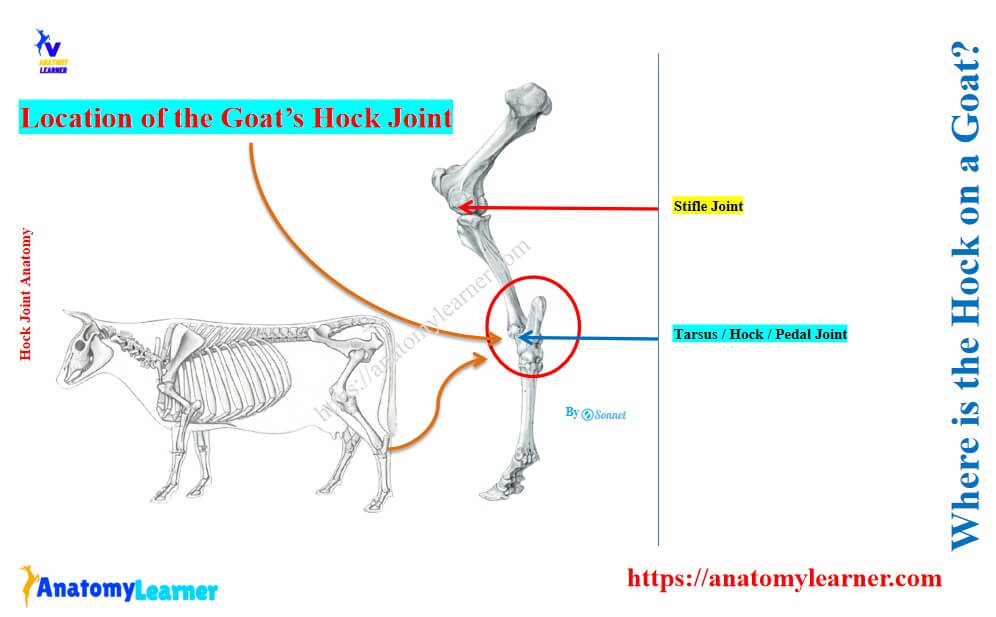
The hock on a goat is the compound joint of its hind limb and is mainly responsible for extension and flexion movement. This article will answer the question ‘where is the hock on a goat’ in detail with labeled diagrams.
Quick answer: the hock on a goat is located among the tibia, tarsals, and metatarsals and consists of tibiotarsal, intertarsal, and tarsometatarsal articulations.
Thus, you will know the exact location and structure of the hock in a goat with proper diagrams. I will also show the variation in the anatomy of the hock joint in other animals like horses and dogs compared to the goat.
Where is the hock on a goat?
The hock is a composite joint of the hind limb of a goat made up of a number of articulations. This joint is also known as the tarsal joint or pedal articulation.
It consists of three articulations –
- Tibio-tarsal articulation – (typical ginglymus type),
- Intertarsal articulation – (gliding type), and
- Tarsometatarsal articulation – (gliding type),
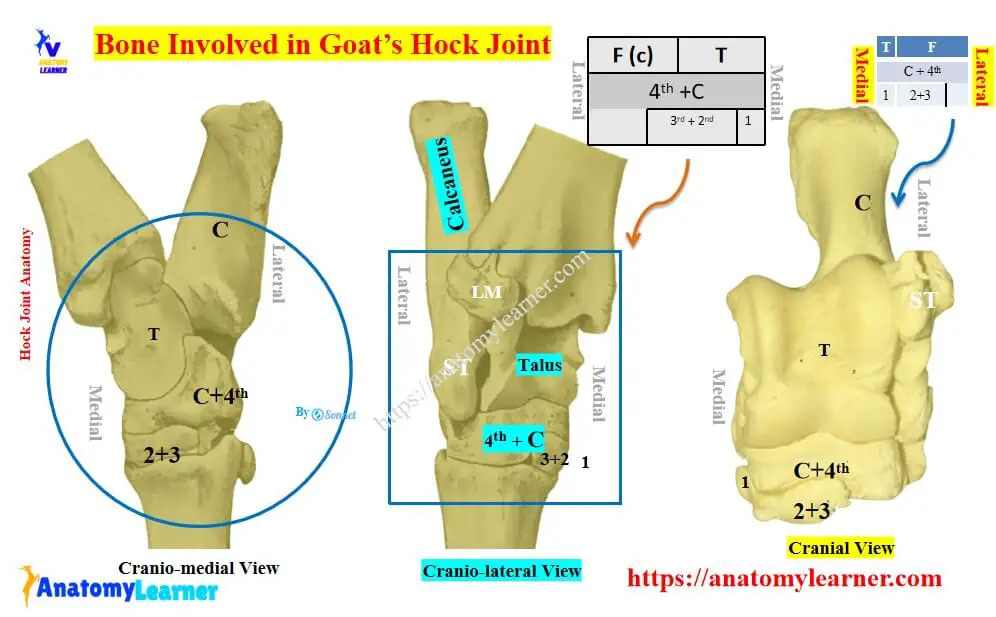
Bone involvement: overall, the distal end of the tibia, tarsals, lateral malleolus, and proximal end of the metatarsal are involved in the hock joint of a goat.
Movement of the hock joint: extension and flexion for the tibio-tarsal joint, and gliding for intertarsal and tarsometatarsal joints.
Here, the tibio-tarsal joint of the hock is formed by the trochlea of the (talus) tibial tarsal and the respective surface of the distal end of the tibia bone. In the case of the goat, the ridges and grooves of these surfaces are directed horizontally.
The intertarsal joint of the hock on a goat is formed by the articular surfaces of the three rows of tarsals. It consists of proximal intertarsal and distal intertarsal joints. Finally, the articular surfaces of the distal row tarsals and the proximal end of the metatarsal form the tarsometatarsal joint of the hock.
What are the ligaments in the hock of a goat?
The hock on a goat consists of a common capsule and ligaments. Again, you will find some special ligament in the structure of the goat hock joint.
- Common capsule: joint capsule / capsular ligament (similar to any synovial joint capsule),
- Common ligaments: lateral and medial collateral ligaments, plantar and dorsal ligaments,
- Special ligaments: there are various special ligaments in tibio-tarsal, intertarsal, and tarsometatarsal joints.
Joint capsule of the hock joint (common capsule)
The joint capsule of the synovial structure consists of 2 layers: the synovial membrane and the capsular ligament. You will find the details description of the joint capsule from the synovial joint anatomy in the animals.
The fibrous or capsular part of the hock’s joint capsule (JC) attaches around the margin of the tibial articular surface above and the metatarsal surface below. You will also find the attachment of this fibrous part of the joint capsule to other parts of the bone, and it blends with the collateral ligament.
This fibrous part of the joint capsule consists of two segments –
- Dorsal part or anterior ligament: it is very thin,
- Plantar part or posterior and tarso-metatarsal ligament: it is very thick and intimately attaches to the tarsal bone.
You will find 4 synovial sacs in the structure of the joint capsule in the hock of a goat –
- Tibio-tarsal synovial sac,
- Proximal intertarsal synovial sac,
- Distal intertarsal synovial sac, and
- Tarsometatarsal synovial sac,
Here, the tibio-tarsal synovial sac is the largest and lubricates the proximal joint. The proximal intertarsal sac lines the joint formed by the talus and calcaneus bones above, and the central and fourth tarsal bones below. This sac communicates with the tibiotarsal synovial sac.
The distal intertarsal synovial sac lubricates the joints formed between the central tarsal and the bone below and on either aspect. Finally, the tarsometatarsal synovial sac lubricates the joint formed between the tarsal and metatarsal bones.
Common ligament in the structure of the goat’s hock
There are two common ligaments in the structure of the goat’s hock –
- Lateral collateral ligament,
- Medial collateral ligament,
- Plantar ligament, and
- Dorsal ligament,
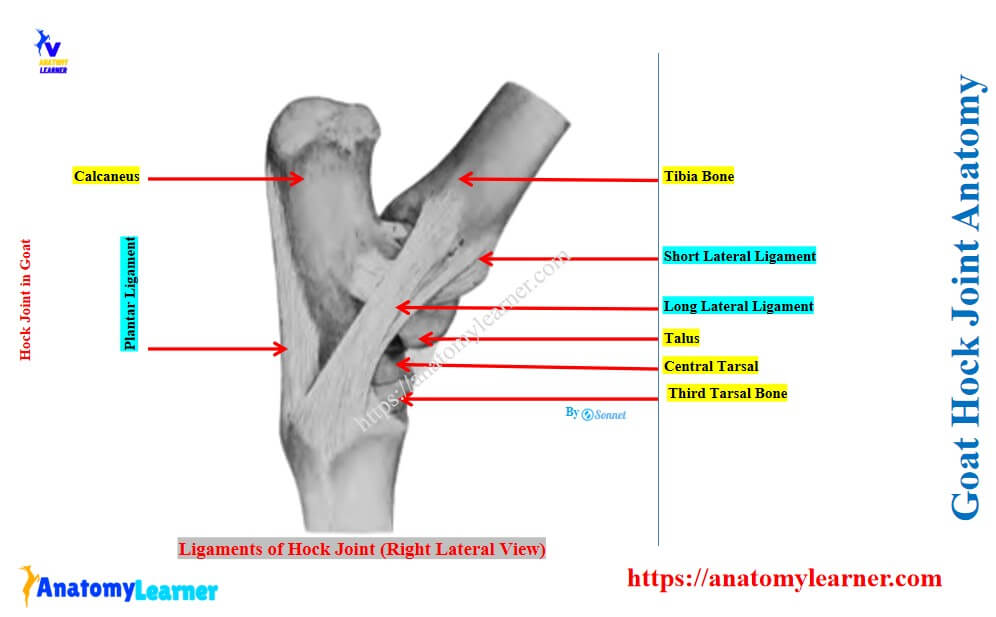
Here, the lateral collateral ligament of the hock consists of two distinct bands which cross each other –
- Long lateral ligament, and
- Short lateral ligament,
Here, the long lateral ligament is superficial than that of the short lateral ligament. It arises from the posterior part of the lateral malleolus and directs straight downward.
This ligament attaches to the fibular and fourth tarsal, and the large and lateral small metatarsal bones.
The short lateral ligament is deep and arises from the anterior part of the lateral malleolus. The direction of this ligament is backward and attaches to the lateral surface of the talus and also the calcaneus bone.
The medial collateral ligament of the goat’s hock also consists of 2 parts, which cross each other –
- The long medial ligament, and
- A short medial ligament,
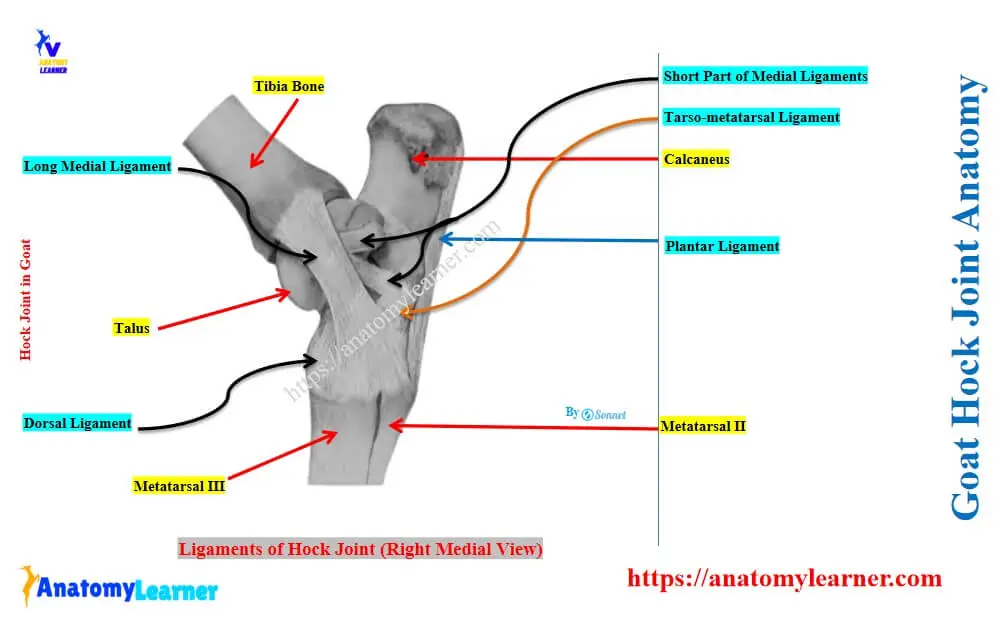
Here, the long medial ligament is superficial and arises from the posterior part of the medial malleolus. It becomes wider and connects to the distal tuberosity of the tibial tarsal, the large and medial small metatarsal, and also the lower tarsal bone.
The short medial ligament lies under the long medial ligament and aeries from the anterior part of the medial malleolus. It runs backward and downward and divides into two distinct branches.
One branch of the short medial ligament attaches to the proximal tuberosity on the medial surface of the tibial tarsal. The other branch attaches to the sustantaculum tail.
Other common ligaments of the goat’s hock joint
The plantar ligament of the goat’s hock joint is flat and very strong. It covers the outer part of the plantar surface (caudal) of the tarsus. This ligament connects to the plantar surface of the fibular and fourth tarsals and the proximal end of the lateral metatarsal bone.
The dorsal ligament of the goat’s hock is a triangular structure. It attaches to the distal tuberosity on the medial surface of the tibial tarsal and spreads out below on the central and third tarsals.
Special ligament of the hock on a goat
There is are good number of special ligaments in the structure of the hock on a goat. They connect the adjacent bones of the tarsus and metatarsus.
Special ligament in the tibial and fibular tarsal bone:
The tibial and fibular tarsal are connected with 4 special ligaments –
- Medial ligament: it extends from sustenticulum tail to the adjacent part of the tibial tarsal. It blends with the short collateral ligament.
- Lateral ligament: it extends from the trochlear process of the fibular tarsal (calcaneus) to the adjacent part of the lateral ridge of the trochlea.
- Proximal ligament: it extends from the posterior margin of the trochlea to the fibular tarsal.
- Interosseous ligament: It extends between two bones and attaches to the opposed bones.
Special ligaments in small tarsal bones (central, third, and fourth):
Let’s see the special ligament in the small tarsal bones on the goat’s hock –
- Interosseous and dorsal oblique ligament: between the central and third tarsal bones,
- Interosseous and lateral transverse ligament: between the central and fourth tarsal bones,
- Plantar transverse ligament: between the third and fourth tarsal bones,
- Plantar and interosseous ligament: between the central tarsal and the tibia bone,
- Short oblique ligament: between the central tarsal and fibula tarsal,
- Plantar ligament: among the first, second, and fibular tarsal,
Special ligaments between the distal tarsal and metatarsal:
You will find the tarsometatarsal ligament that connects the distal tarsal bones with the metatarsals.
Where is the hock on a horse located?
The hock on a horse is located in the hindlimb among the distal end of the tibia, tarsal bones, lateral malleolus, and proximal end of the metatarsal bones. The common capsule and ligaments are almost similar in structure to the goat’s hock. But the special ligaments are quite different in horses than those of the goats.
What are the unique features of the hock in a cow?
You will find a distinct variation in the hock joint structure of a cow compared to that of a goat. The unique features of the hock joint in a cow are –
- The joint capsule is considerably roomy in the cow’s hock,
- There is considerable mobility at the proximal intertarsal joint of the cow’s hock,
- The short lateral ligament attaches distally on the talus only.
- A strong transverse ligament attaches the lateral malleolus to the plantar part of the talus bone.
- The dorsal ligament is narrow and thin,
Conclusion
The hock is a composite joint on a goat and consists of tibio-tarsal, intertarsal, and tarso-metatarsal articulation. Here, the tibio-tarsal articulation is a ginglymus type joint, whereas the other two are gliding type joints.
The extension and flexion are the main movements for the tibio-tarsal joint. Again, gliding movement occurs in the intertarsal and tarsometatarsal articulation of the goat’s hock.
